
Can Social Media Posts Become Court Evidence?
Can Social Media Posts Become Court Evidence? Here’s What the Law Says
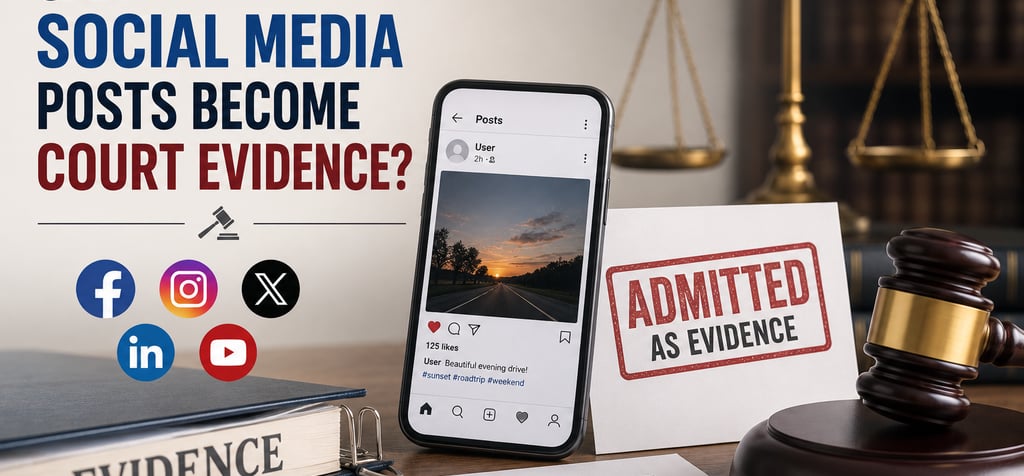
Can Social Media Posts Become Court Evidence? Here’s What the Law Says
In today’s digital world, people often share their thoughts, photographs, chats, emails, and personal disputes online without realizing that these posts can later become important legal evidence in court. A WhatsApp message, Facebook post, Instagram story, email, or even a screenshot can sometimes play a crucial role in civil, criminal, matrimonial, corporate, or cyber litigation.
Under Indian law, electronic records are legally recognized as admissible evidence. The provisions relating to electronic evidence are primarily governed by the Information Technology Act, 2000 and the Bharatiya Sakshya Adhiniyam, 2023 (earlier Indian Evidence Act, 1872). Courts today increasingly rely upon digital communication in matters involving online fraud, cybercrime, defamation, threats, matrimonial disputes, financial transactions, harassment, cheating, and business disagreements.
Electronic evidence may include:
WhatsApp chats,
Emails,
Audio/video recordings,
CCTV footage,
Social media posts,
Call recordings,
Screenshots,
Digital documents and online transactions.
However, many people unknowingly create legal complications for themselves by posting emotional or defamatory content online during disputes. A social media post made in anger may later be used against the person who uploaded it. Publishing false allegations, sharing private information, morphing images, or forwarding offensive content may also attract civil as well as criminal liability.
Depending upon the facts of the case, offences relating to online conduct may involve provisions under:
Information Technology Act, 2000,
Bharatiya Nyaya Sanhita, 2023,
Laws relating to defamation,
Privacy violations,
Cyber fraud,
Identity theft,
Online harassment and intimidation.
At the same time, electronic evidence must also satisfy legal requirements regarding authenticity and admissibility. Courts generally examine whether the digital material is genuine, properly preserved, and legally proved before relying upon it during proceedings.
The internet may feel casual, but legally, online actions often carry serious consequences. Before posting, forwarding, or reacting publicly during any dispute, it is always advisable to think carefully and seek proper legal guidance.
At The Lawgical Professionals, we assist clients in matters relating to cyber law, social media disputes, electronic evidence, online defamation, cybercrime, criminal litigation, and digital legal protection in the evolving online landscape.